
Text Scripts
This script shifts that belief. Instead of rehashing why their home didn’t sell, it focuses on what’s changed. More buyer activity. Homes like theirs moving again. A potential opportunity they didn’t realize existed.
By offering a simple, no-obligation home value update, you open the door to a fresh conversation—one that could lead to them reentering the market with you.
This script challenges that old way of thinking. It introduces a proactive, strategic approach—one that attracts the right buyers instead of waiting for them to show up. By positioning yourself as the agent who has a better plan, you immediately stand out from the crowd.
Use this script to spark curiosity and start a conversation that leads to action.
This script helps break through that hesitation. By offering a detailed market analysis—instead of a sales pitch—it gives sellers a way to understand what happened and what’s changed. Even if they’re not ready to relist today, this insight keeps you top of mind when they are.
Use this script to provide clarity, build trust, and make sure you’re the agent they turn to when they’re ready to move forward.
This script works because it delivers value first. Instead of pushing them to relist, it offers a Professional Listing Review—a no-obligation analysis that pinpoints why their home didn’t sell and how to fix it. That kind of insight builds trust, creates curiosity, and makes it easier for sellers to take the next step.
Use this script to shift the conversation from frustration to solutions—and put yourself in position to win the listing.
This script sparks curiosity by sharing a real success story. Instead of talking about failure, it paints a picture of possibility—proving that with the right approach, their home can sell. When sellers see what worked for someone else, they naturally start wondering: Could this work for me too?
Use this script to plant that seed and position yourself as the solution they’ve been looking for.
This script helps homeowners see the bigger picture. It steers the conversation away from just dropping the price and instead focuses on positioning their home the right way. When you introduce a fresh perspective, you shift their mindset—and that’s when they start seeing you as the agent who can get the job done.
Use this script to guide the conversation and establish yourself as the expert they need.
This script changes the approach. It validates their frustration and shifts the conversation from what went wrong to how to make it right. Instead of pushing, it opens the door to a real dialogue—one that positions you as the agent who actually understands their challenges.
Use this script to disarm objections, build trust, and start conversations that lead to listings.
In times of uncertainty, your past clients aren’t just looking for market updates—they’re looking for reassurance. The recent news around U.S./Canada tariffs and economic shifts has left many wondering what it all means for them.
This is a great moment to check in, not to sell, but to show you’re there as a trusted resource. A simple, open-ended question like “How are you feeling about the market right now?” invites conversation and reminds them you’re paying attention—so they don’t have to navigate it alone.
Here’s how to reach out in a way that feels natural and valuable.
Mortgage demand just jumped 20% in a single week. That’s not just a number—it’s a reason to reach out.
Buyers are watching rates closely, and with more of them jumping back into the market, competition is heating up. This shift could mean stronger offers and better opportunities for sellers—but only for those who are paying attention.
Now is the perfect time to check in with prospects and spark a conversation. A simple, easy-to-answer question like “Have you been keeping an eye on the market?” can open the door to a meaningful discussion.
Send this text to 25-50 prospects.
‍
Most FSBO sellers screen calls from unknown numbers—especially from agents. If they didn’t pick up, it’s not necessarily a “no.” It just means they don’t know why they should talk to you yet.
This text is short, direct, and creates curiosity. Instead of sounding like another agent trying to “win the listing,” you’re positioning yourself as someone with genuine interest in their home. No sales pitch, just a reason for them to call you back.
The goal? Get them to engage. Once they respond, you can shift the conversation toward value—helping them, not selling them.
Once you get them on the phone, use 1 of these 3 call scripts:
- FSBOÂ Pricing Call Script
- FSBOÂ Photos Call Script
- FSBOÂ Listing Description Call Script
Most FSBO sellers write their listing descriptions like a checklist—bedrooms, bathrooms, square footage. But buyers don’t connect with stats. They connect with stories.
‍
A home isn’t just a structure. It’s where life happens. The right description doesn’t just inform—it makes buyers picture themselves living there. And yet, most FSBO listings fall flat, blending into the sea of generic homes online.
‍
By guiding sellers to craft a description that sparks emotion, highlights key features, and makes their home stand out, you’re giving them a serious edge in the market.
Most FSBO sellers assume if their home is priced right, buyers will come. But the truth? Buyers don’t just shop with logic—they shop with emotion. And nothing triggers emotion faster than great photos.
‍
Bad lighting, missing key shots, or too few images can make even a well-priced home invisible in a crowded market. The problem? FSBO sellers don’t always know what’s turning buyers away.
‍
By offering strategic photo tips—simple fixes with big impact—you’re helping them attract more buyers without spending a dime. No pressure, no sales pitch—just real advice that makes their listing stronger.
Most FSBO sellers don’t fail because they lack effort. They fail because they don’t have the right data.
They think selling solo means more control—but without access to real market insights, they’re often guessing on price. Many can’t afford an appraisal, and online estimates? Inaccurate at best, misleading at worst. The result? Overpricing that scares buyers away or underpricing that leaves money on the table.
By offering a Comparative Market Analysis (CMA), you’re giving them something they don’t have—real data on what homes are actually selling for. No pressure, no pitch—just valuable insights to help them make informed decisions. Lead with this, and you won’t just start a conversation. You’ll earn their trust.
The #1 reason why your clients won't sell their current home might be because they have a great interest rate. But as rates drop, they might be more open to the idea of making a move.
‍
Let's take the opportunity of rates dropping below 7% to engage your SOI and find your next listing.
Forget the hard sell. Instead, market like you gossip. Instead of laying out every detail, tease your audience with just enough insider information to spark curiosity.Â
‍
Imagine texts that start with, "I probably shouldn’t be telling you this but…" and then hint at great deals or hidden opportunities. Research shows that curiosity-driven messaging can boost engagement significantly.Â
‍
Challenge the norm—let this campaign show you how a playful, coy approach can help you start more conversations.
‍

This text is your foot back in the door with leads who’ve been on the fence about buying—a low-pressure way to reopen the conversation and see where they stand.Â
A simple check-in can be the nudge they need.Â
Use any of the statements provided—or create your own.
‍

‍
Every season gives you a built-in excuse to reach out. The question is: are you using it?
Right now, as summer winds down, people are shifting gears. Vacations are ending. Kids are heading back to school. And the focus that drifted away in June and July is coming back to real estate in August. That’s your moment.
We’ve used this exact formula before; remember the Post-Election Text back in November? It sparked countless conversations and opportunities for ListingLeads members. Same structure, same psychology, just adapted for the season we’re in today.
Simple texts start powerful conversations. This one works because it isn’t pushy—it’s curious. When you ask a homeowner what the next owner would love, you shift their mindset from “this is my house” to “someone else living here.”Â
That’s a subtle but important mental bridge toward selling.Â
Plus, it feels personal and easy to answer, which means you’ll get more replies, and more insight into what matters to them.
This script taps into a powerful behavioral science concept from Chase Hughes: the Identity Agreement. You’re not just offering data, you’re inviting someone to step into the role of “the informed one,” the person who knows what’s really happening in the market. And most people want to see themselves that way.
By leading with curiosity (“I figured you’d appreciate a different perspective”) and offering specific, local insights (“which price points are moving fastest”), you position yourself as the agent who brings clarity in a noisy market.
It’s short. It’s disarming. And it opens the door for a real conversation.
Copy it exactly, or swap out the offer to what makes the most sense for your market. Just keep the structure, because that’s what makes it work.
This text is short, personal and built to get referrals.
It’s rooted in research from behavioral expert Vanessa Van Edwards, who found that high-warmth cues - like compliments that feel earned - are one of the fastest ways to build trust and spark engagement.
That’s exactly what the opening line does: “You always seem to know someone who’s thinking about moving.”
It makes the person feel seen, connected, and credible.
From there, the message shifts into a strategic ask where you highlight an opportunity: You’re taking on 1–2 more serious buyers (or whatever that number is for you) this month.
Use this when you want to re-engage your network without sounding transactional - and start more meaningful conversations that lead to real referrals.
IIf you have access to off-market deals, consider sending this version instead.
This text is short, personal and built to get referrals.
It’s rooted in research from behavioral expert Vanessa Van Edwards, who found that high-warmth cues - like compliments that feel earned - are one of the fastest ways to build trust and spark engagement.
That’s exactly what the opening line does: “You always seem to know someone who’s thinking about moving.”
It makes the person feel seen, connected, and credible.
From there, the message shifts into a strategic ask where you highlight an opportunity: You’re taking on 1–2 more serious buyers (or whatever that number is for you) this month to help them find an off-market deal.
Use this when you want to re-engage your network without sounding transactional - and start more meaningful conversations that lead to real referrals.
If sourcing off-market homes isn’t something you offer, try this version instead.
Every season gives you a reason to reach out to your clients. The shift into fall is one of the easiest—and most natural—times to do it.
This isn’t about pushing a listing or forcing a market update. It’s about opening a conversation. A quick, personal check‑in that reminds people you’re there, you’re paying attention, and you’re ready to help if real estate is on their mind.
This simple text does exactly that. It’s short, casual, and easy for anyone to respond to. Send it now, and you’ll spark conversations that you might not have otherwise.
‍
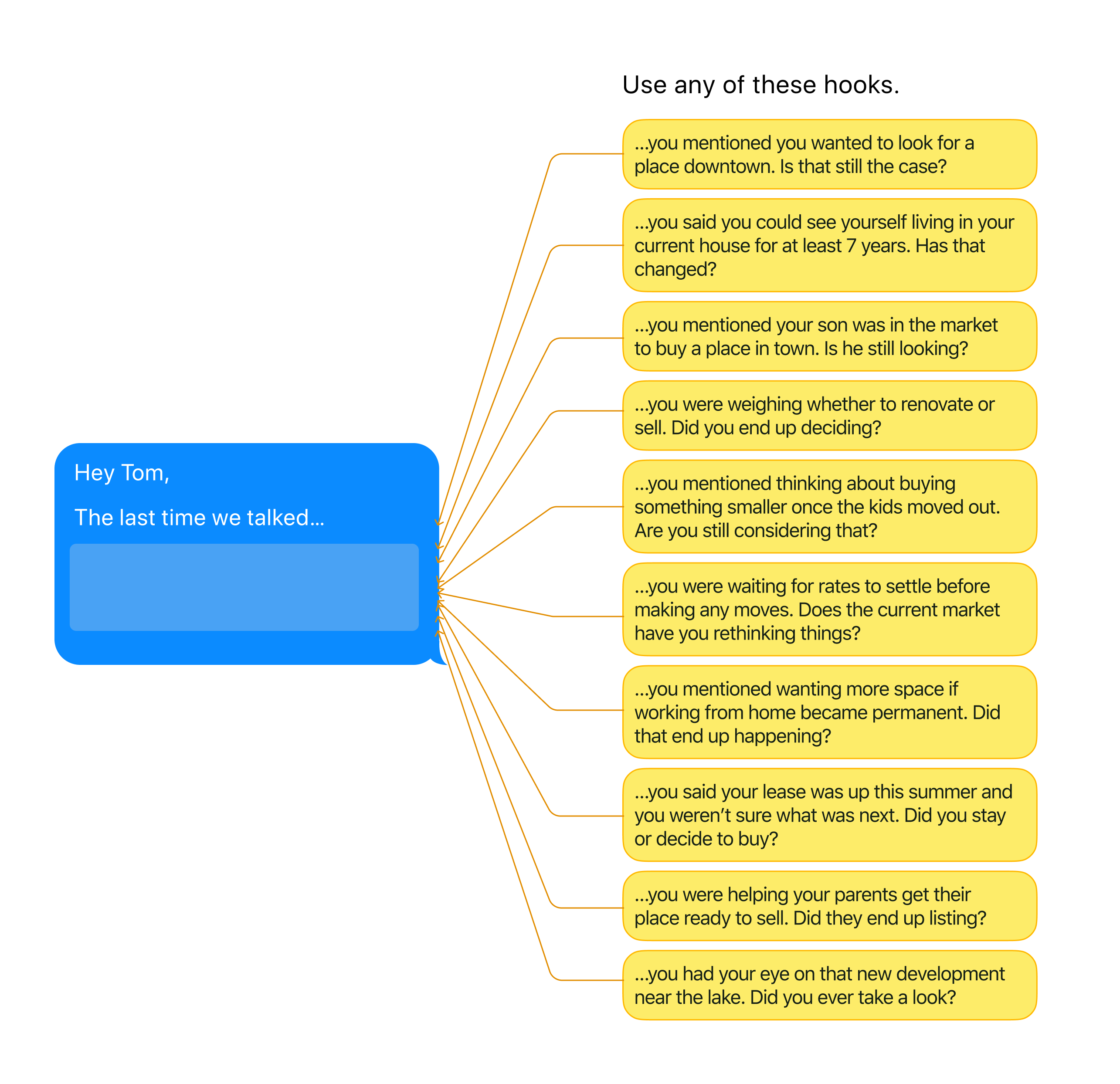
There’s one phrase that reopens doors faster than just about anything else: “The last time we talked…”
It’s disarming. It’s personal. And according to behavioral researcher Vanessa Van Edwards, it taps directly into one of the most powerful social triggers we have: being remembered.
When someone recalls a detail you shared months (or even years) ago, it hits differently. It signals care, credibility, and emotional intelligence, without needing to sell a thing. And for leads who’ve gone quiet, it gives them the perfect on-ramp back into the conversation.
This text campaign puts that principle into action. We’ve provided 10 conversation starters - each one built to spark a reply based on something they once shared with you. You only need one. But you do need to personalize it.
Pro tip: Go back through your email threads, DMs, and CRM notes. Look for that small detail, what they said about rates, renovations, location, timing. That’s your opening.
‍

Most scripts put people on defense. This one opens the door.
In a market full of hesitation, your message has to do more than inform - it has to disarm.
That’s why we built this text around three words I picked up from a Lewis Howes video: What’s the chance? It’s playful, non-threatening, and it bypasses the part of the brain wired to shut down salesy conversations.
Instead of pressure, it invites possibility. And for buyers who’ve felt sidelined the last two years, that’s exactly the kind of nudge that gets them to re-engage.
This referral text is simple but strategic.
It’s based on research from Vanessa Van Edwards, a behavioral expert who studies how warmth, trust, and status drive responses.
Here’s what makes it work:
1. It opens with a high-warmth cue—“You’re so well-connected”—which triggers trust and makes the person feel seen.
2. It keeps the ask mutual, not transactional. You’re not selling—you’re inviting them into something valuable.
3. It uses power + warmth language to describe the listing. Instead of underselling it (“might be a good fit…”), you’re quietly signaling urgency and quality.
Send it now if you’ve got a great listing to a contact who knows everyone.
When buyers re-enter the market, it usually starts with curiosity.
Not bold moves—just a sense that the timing might be better.Â
This text leans into that energy with a useful offer at the right moment.
Even a small rate dip can reset the conversation.
Not just because affordability improves—but because buyers start to feel the difference. According to Redfin, a recent drop from 7.08% to 6.67% gave buyers with a $3K/month budget an extra $16,000 in purchasing power. That subtle shift can be enough to re-engage someone who’s been sitting on the sidelines.
This text uses a light touch to invite that kind of buyer back into the dialogue.
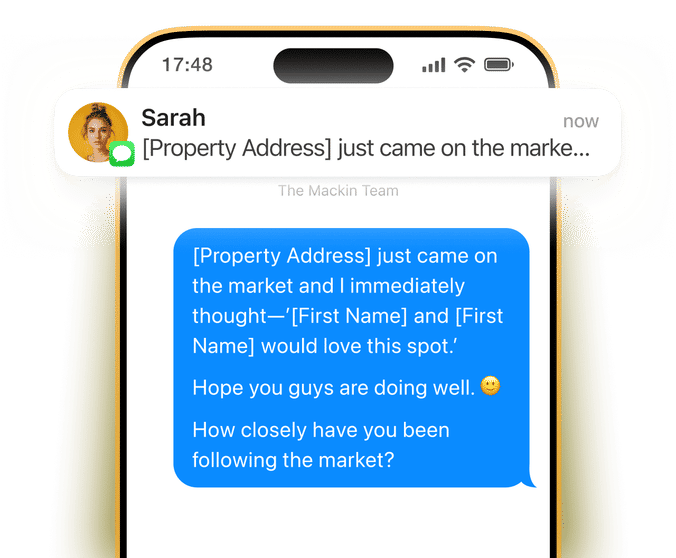
Sometimes the best follow-up isn’t about market stats or drip campaigns.
It’s about being human.
This text gives you a simple, personal reason to reach out to past clients—without sounding like you’re “just checking in.”
Here’s the idea:
If a home hits the market that reminds you of someone you’ve worked with—same style, similar layout, same street or school zone, close to a neighborhood they mentioned loving—you send a quick note to let them know you thought of them.
It’s casual. It’s thoughtful. It’s genuine. And it opens the door to a real conversation.
We’ve tested a lot of scripts—but this one works faster than most.
It’s simple. Personal. And rooted in real psychology.
This is the kind of question that reopens the conversation without feeling salesy… even for leads who’ve gone completely dark.
Here’s the 10-word text that’s driving replies right now:
Hi Tom—
Have you given up on trying to buy a home this year?
Give it a shot. You might be surprised how many people answer.
We created this text campaign to solve a common (and costly) problem: vague, low-performing follow-ups. You know the line—"Just following up…” It’s overused, easily ignored, and signals you don’t have anything new to offer.
This campaign flips that script.
We’re replacing generic follow-ups with a confident, curiosity-driven opener: “This might be worth a quick conversation but I could be wrong.”‍
It’s disarming, conversational, and gives the recipient permission to say no—while still inviting engagement.
From there, we position the message around active buyer demand and the idea of “just seeing if there’s a number you’d consider,” even if selling isn’t on their radar. It’s direct, low-pressure, and refreshingly honest.
The goal?
Spark conversations with homeowners who aren’t actively selling—but might be willing to consider an off-market deal for the right price.
More Canadian homeowners are tapping into their equity this year—driven by rising renewal volumes, increased HELOC usage, and a growing need to make smart financial decisions without giving up a low-rate mortgage.
That makes this the perfect time to bring back a strategy that’s worked exceptionally well: the unsolicited CMA.
Reach out to 5–10 people in your sphere or past clients with a quick, personalized equity update—no ask, no pressure, just timely insight.The text below helps you start the conversation—and positions you as the steady, informed guide they want in their corner.
$25 billion in equity was pulled last quarter—the highest Q1 total since 2008, according to ICE Mortgage Technology. And the average U.S. homeowner is now sitting on over $200K in tappable equity.
That makes this the perfect time to bring back a strategy that’s worked time and time again: the unsolicited CMA.
Reach out to 5–10 people in your sphere or past clients with a quick, personalized equity update.
The text below makes it easy to start the conversation—and reminds them exactly why they trust you.
‍
This text works because it turns a simple follow-up into a high-response moment. Everyone who opened yesterday’s email is your prospecting list for this script.
The apology is the hook. It feels human, unscripted, and disarming.
Most agents close with low-status lines like “Let me know” or “Just following up.” Those phrases put you in a waiting position. High-status phrasing, the kind Mark Satterfield teaches, flips that dynamic. It shows confidence, direction, and leadership, exactly what clients want from an agent.
People love an apology
here's the thing is I will say this is the I'm sorry script is a killer killer
way to re-engage people who have let's say you miss an opportunity. So Sam
let's say you were part of my open house as an example.
script as a way to sort of bridge that gap for any old open house leads, but I'm not doing that mass marketing. I'm definitely doing that as a onetoone text.
Anyone who opened yesterday’s email is your prospecting list for this text. They’ve already shown interest - that’s all the qualification you need. This message is designed to follow up that signal in a way that feels personal, intentional, and low-pressure.
The key phrase here is: “The last time we talked you mentioned…”
Vanessa Van Edwards, a famous psychologist, teaches that this line immediately increases likability because it shows you listened and remembered. In real estate, being likable and competent builds trust quickly.
The hooks provided are simply examples, use the one that matches your actual past conversation with this person. The goal is to reference something specific, then end with an open, non-pushy question.
‍

This text is simple, sincere, and perfectly timed. Right now is the ideal moment to reach out to your 2025 clients with a quick message of genuine appreciation. These are the relationships that matter, and a small, thoughtful touch goes a long way.
The script is intentionally warm and straightforward. Use it as written, or personalize it with a detail from their move.Â
Pro-tip: Send this as a text or a 1:1 off-the-cuff video. It doesn’t need to be polished, authentic always beats produced.
This text is designed for everyone who opened your last email but didn’t respond.
It feels personal, conversational, and creates an easy opening for a reply without pressure.
Use it to re-engage homeowners who are sitting on the fence. It combines empathy about uncertainty with a soft offer of insight about what is actually selling right now.
This text works because it’s built on two simple but powerful psychological triggers: social proof and likability.
The opening line - “It seems like every week lately I hear from someone…” - taps into social proof, the idea that people look to others’ behavior to guide their own decisions. It lowers resistance by showing that change is normal right now, not risky.
Then comes likability, one of the most studied principles in persuasion. As Vanessa Van Edwards teaches, people are far more likely to respond to someone who makes them feel seen and valued. “Made me think of you” does exactly that - it’s warm, personal, and human.
The question at the end is strategic too. You’re not asking something abstract, you’re asking what they already know. That’s how you start more conversations that actually go somewhere.
Two years ago, rates were 7.91%. Now, they’re flirting with the fives.
Five isn’t just another number, it’s the magic number.
When rates are in the sixes, only 6% of prospective sellers think about selling. In the 5’s, that number jumps to 35%.
So what can you do with this information?
Use it to book your next appointment. Send this text to 50 prospects today.
This time of year is perfect for a soft, strategic touchpoint.
As the year winds down, homeowners start thinking about what’s next - new goals, new plans, maybe even a move in 2025. That’s your cue to step in with something valuable: a personalized home value report.
Sure, you could blast it out to your whole list. But a smarter move is to focus on the people who opened yesterday’s email. That subject line did the qualifying for you. If they opened, they’re curious, and this text is your natural next step.
Rates just gave you the perfect reason to text.
With the daily average dipping to around 6.17% (the lowest we’ve seen in nearly three years) buyers are waking up again.
This text builds on that moment - with a home value angle. Send it to everyone who opened yesterday’s email.
This text is built to start conversations, especially with buyers who are curious but not yet committed. Everyone who opened yesterday’s email is your prospecting list for this one.
They’ve already shown interest by engaging with your email, so this is your chance to follow up while the curiosity’s still warm. The script works because it lowers defenses fast (“I know this is probably the wrong time”) and follows with a soft, natural ask (“out of curiosity…”).
It’s simple, disarming, and designed to get a reply.
Everyone who opened yesterday’s email is showing you something important: curiosity. They’re paying attention. That’s your prospecting list for today.
Reference the email as a relevant opening, then ask a question that’s easy to answer: “What’s one feature your current home is missing that your next one has to have?”
One of the secrets we’ve learned for effective outreach? Ask a question they already know the answer to.
Time to start more conversations.
This text is short on purpose, just one line. Have you given up on trying to buy a home this year? It’s straight out of Chris Voss’ playbook. By framing the question negatively, you lower defenses and invite an honest response. People are more likely to correct you (“No, I haven’t given up…”) than agree, which gets the conversation moving.
Send this to everyone who opened yesterday’s email and watch how many conversations you start.
This is where yesterday's email and this text strategy really comes together. Yesterday’s subject line did the heavy lifting: it got people to reveal themselves. They opened because they were curious what happens if rates drop. That’s intent. That’s interest. That’s how you qualify through copy.
Now you follow up with a simple, targeted text. Lead with real proof: you just helped a buyer lock in a lower rate. That’s news worth sharing. Then extend a clear, personal offer: “Want to see what your monthly payment would look like at [%]?”
It’s short. It’s direct. And it keeps the conversation moving forward with the people who already raised their hand.
This is where yesterday's email and this text strategy really come together. Yesterday’s subject line did the heavy lifting: it got people to reveal themselves. They opened because they were curious what happens if rates drop. That’s intent. That’s interest. That’s how you qualify through copy.
Now you follow up with a simple, targeted text. Lead with real proof: you just helped a buyer lock in a lower rate. That’s news worth sharing. Then extend a clear, personal offer: “Want to see what your monthly payment would look like at 6%?”
It’s short. It’s direct. And it keeps the conversation moving forward with the people who already raised their hand.
This one’s built for your SOI and past clients.
It’s a simple check-in without any agenda.
You lead with “I know you’re not in the market” which instantly lowers their guard. Then you layer in “I thought of you,” which, as Vanessa Van Edwards teaches, boosts likeability and connection.
From there, pick one of the hooks based on what’s happening near them:
• …just got listed and I thought of you. What do you think of the list price?
• …just had a price reduction and I thought of you. What do you think of the new price?
• …just sold and I thought of you. Did you see the final sale price?
It’s casual, relevant, and easy to respond to, which is exactly what keeps the conversation (and relationship) going.


-1.png)
-1.png)


